Module · Detail
Caesar Cipher in Python
This module introduces basic concepts of encryption and character processing in Python. It connects algorithmic thinking with the implementation of mathematical operations in a functional structure.
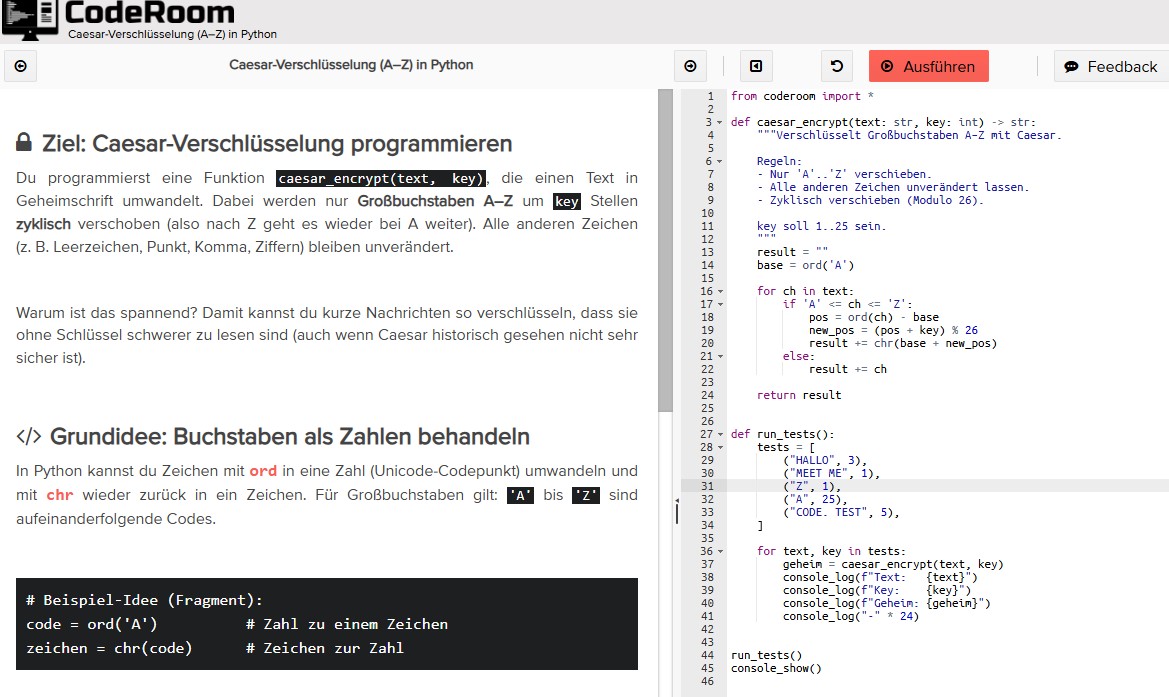
Introduction (Original excerpt)
Didactic Classification
Subjective Objective
The module introduces the fundamental functionality of simple encryption methods and connects this to central concepts in programming. At its core is the implementation of a Caesar cipher, where characters are systematically transformed. The mapping of characters to numbers using ord() and chr() is utilized and a cyclic shift is realized through modulo arithmetic. Learners structure the algorithm as a function and apply it to character strings. The connection between mathematical model (number range 0-25) and concrete implementation is explicitly established.
Competence development
- Understanding of Caesar cipher as a simple cryptographic procedure
- Conversion of characters to numerical values with
ord()and back withchr() - Application of modulo arithmetic for cyclic shift
- Iteration over character strings using loops
- Conditional processing of characters based on criteria (A-Z)
- Structuring algorithms in functions
- Distinguishing between changeable and unchanged input parts
Didactic added value in teaching
- Clear connection between mathematical concept and programming
- Structured task assignment with clear requirements
- Promoting algorithmic thinking through step-by-step implementation
- Transparent goal orientation through verifiable results
- Good opportunities for differentiation through additional test cases
- Categorization in larger topic areas such as cryptography and security
Flow of the lesson unit
Caesar encrypt: Function complete
In this step, the central function for Caesar encryption is implemented. Only uppercase letters are transformed, while all other characters remain unchanged. The task focuses on correct implementation of cyclic shift and structured processing of a text character by character.
- Didactic focus: Connection between character processing and modulo arithmetic
- Typical challenge: Correct implementation of cyclic shift and fall-through
Work assignment (excerpt)
2. Leave all other characters unchanged
3. Correctly implement cyclic shift with modulo 26
4. Verify results using test cases
Example (excerpt)
| |
This fragment illustrates the central transformation of characters through numerical representations and modulo arithmetic.
Hints for teaching practice
- The module can be integrated into a lesson unit on cryptography or algorithms
- Differenzierung is possible over additional tasks such as decryption or extension to lowercase letters
- Results can be secured by comparing with known examples
- Extensions are offered through other encryption methods
- Connection points exist to topics such as data security and information processing.
The clear structure of the task supports targeted implementation and facilitates organization and securing results in class.
Request a demo access and test the module in your own course context.