Module · Detail
Simple Password Hash & Mini-Login
This module conveys basic principles of password processing through hash functions. It shows how comparison logic and character processing are used to implement a simple login mechanism.
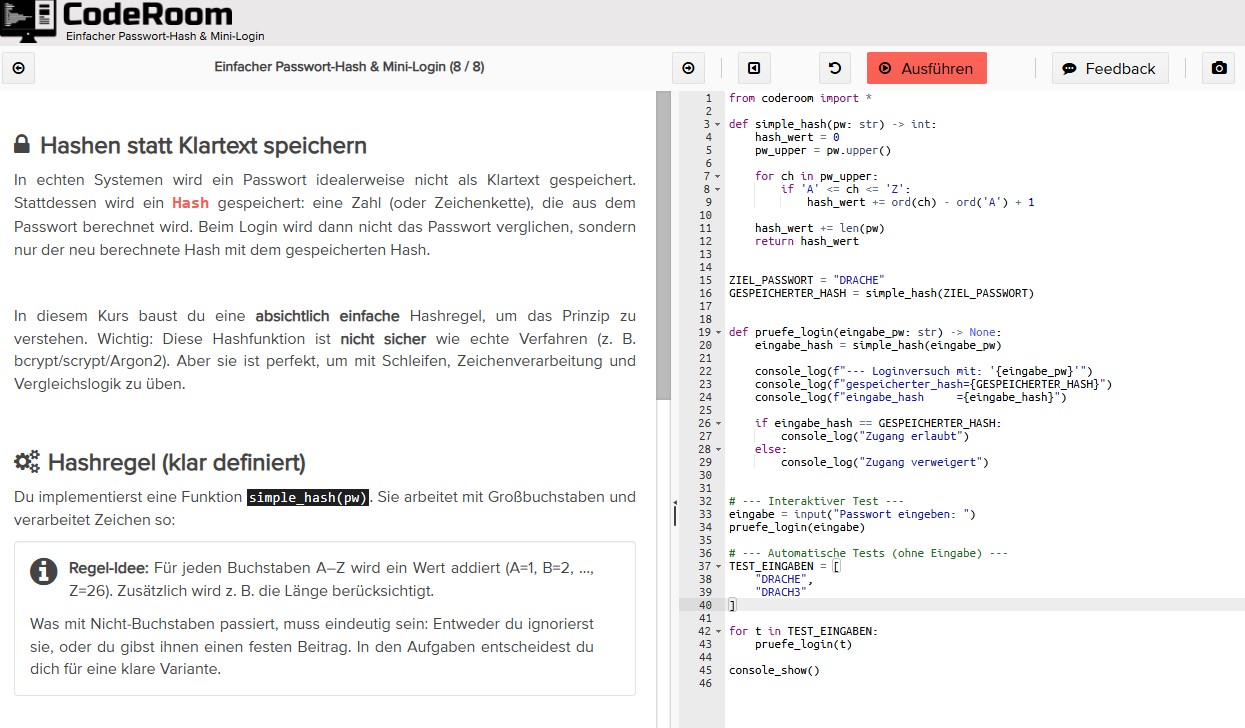
Introduction (Original excerpt)
Didactic classification
Subjective objective
The module introduces the fundamental principle of hash functions and their application in authentication systems. It develops a simplified procedure that converts the characters of a password into numerical values and combines them into a hash value. Learners structure the processing using loops and conditions and make clear decisions about handling different character types. In the second step, this model is transferred to a login scenario where only hash values are compared, not the plaintext. The connection between abstract security concepts and concrete implementation is in the foreground.
Competence development
- Understanding the difference between storing plaintext and hash values
- Implementation of a simple hash function based on character values
- Application of loops for processing character strings
- Use of conditions to filter specific character types
- Structuring programs in functions
- Comparison of values for decision-making (login logic)
- Reflection on consistency and uniqueness of rules
Didactic added value in teaching
- Introduction to a practical concept of IT security in simplified form
- Clear structuring of the task into understandable sub-steps
- Promoting algorithmic thinking through rule-based processing
- Transparent goal orientation through verifiable results
- Differentiation by extending the hash rules or tests possible
- Connection between theory (security) and practical implementation
Lesson flow
Building a hash function (A=1…Z=26)
In this step, a simple hash function is developed that systematically processes the characters of a password. Only uppercase letters are considered, while other characters are deliberately ignored and the length of the original string is also taken into account.
- Didactic focus: rule-based transformation of characters into numerical values
- Typical challenge: consistent handling of different character types
Mini-login: compare hash instead of plaintext
Building on the hash function, a simple login system is implemented that only compares hash values. Both input and reference values are processed and the result of the check is made transparently.
- Didactic focus: comparison logic and application of a model in an application context
- Typical challenge: correct linking of hash calculation and decision structure
Work assignment (excerpt)
2. Systematically process characters and calculate numerical values
3. Implement a login procedure that compares hash values
4. Check results using test inputs and display them
Example (excerpt)
| |
This fragment shows the central conversion of characters into numerical values as the basis for hash formation.
Notes for classroom practice
- The module is suitable as an introduction to IT security and data processing topics.
- Differentiation is possible through alternative hash rules or extension of the login system.
- Results should be systematically checked by comparing hash values.
- Extensions can include additional security aspects or more complex procedures.
- There are connections to cryptography and authentication systems.
The clear structure supports step-by-step implementation and enables transparent result storage in the classroom.
Request a demo access and test the module in your own course context.