Module · Detail
Who do I write the task for?
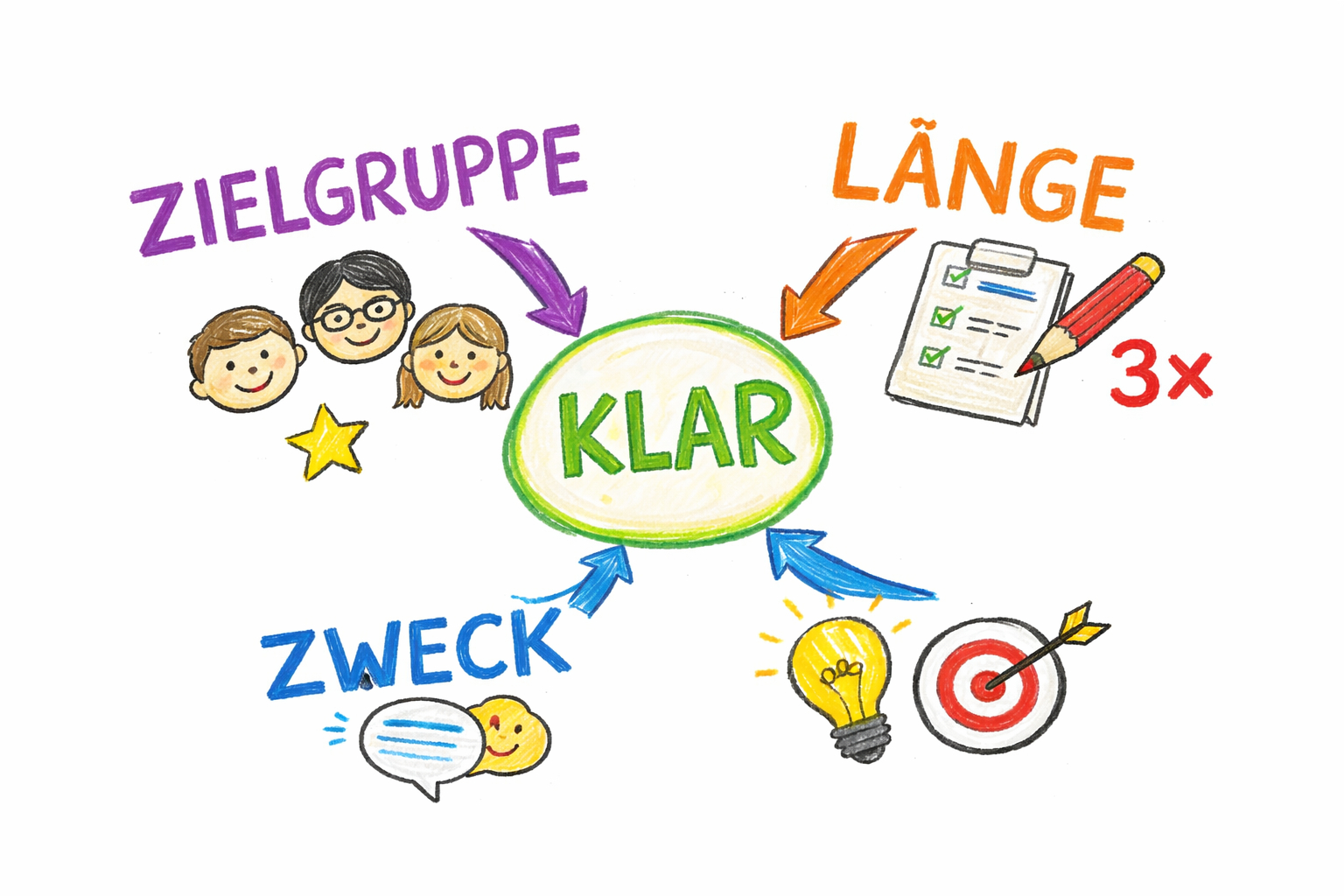
This module conveys the targeted control of AI outputs by specifying a target group in the prompt. It supports building a basic understanding of how language and complexity can be systematically adapted.
Introduction (Original excerpt)
Didactic classification
Subjective objective
The building block introduces a central concept of prompting: explicit specification of a target group to control language style and content depth. It becomes clear that identical questions can be formulated and structured differently depending on the addressee, resulting in different answers. Learners analyze differences in word choice, complexity, and precision and apply these insights to their own formulations. The task requires conscious modeling of communication situations where the context of the target group is explicitly made. The connection between linguistic modeling and technical implementation in prompts stands at the center.
Competence development
- Understanding the target group as a controlling element in prompts
- Analysis of language differences in AI-generated answers
- Adapting task assignments to different addressees
- Developing structured prompts with clear context specification
- Reflection on understandability and linguistic complexity
- Comparison of results under varying prompt conditions
Didactic added value in teaching
- Clear focus on a central principle of prompting
- Low-threshold entry through comparable examples
- Promoting conscious language design and reflection
- Structured tasks with direct feedback through comparison
- Supporting differentiated consideration of understandability
- Connectivity to topics like communication and media competence
Flow of the lesson unit
Write a task with target audience in mind
In this step, a general task is specifically reformulated for a defined target audience. Additionally, it is determined how the answer should be structured to enable controlled output.
- Didactic focus: conscious control of language through target group specification
- Typical challenge: precise formulation of context and requirements
Work task (excerpt)
2. Clearly define the expected answer structure
3. Analyze differences in resulting answers
Example (excerpt)
| |
This fragment illustrates how the target group and format specifications deliberately influence the output.
Hints for classroom practice
- The module is suitable as a short introduction to the topic of prompting and can be flexibly integrated
- Differentiation is possible through variation of target groups and task formats
- Results should be compared and reflected upon jointly
- Extensions can occur through more complex target groups or additional criteria
- Points of connection exist to communication, language awareness, and media education
The clear task structure supports a targeted analysis of language differences and facilitates classroom implementation as well as result verification.
Request a demo access and test the module in your own course context.