Course Template
Basic Principles
Course for Optimizing AI Prompts: Structure, Word Choice, Uncertainty, Facts/Opinions, Learning Support, and Data Protection.
Educational Objective
This course template supports you in systematically building competencies in working with AI-supported dialogue systems through the structured development and refinement of prompts. The focus is on clear prompt structures, targeted control of answers through word choice, and methodical visibility of uncertainty and verifiability. The template combines modeling requirements (role, task, format) with their consistent implementation in repeatable prompt iterations. From a professional perspective, it is to be assigned in the context of reflective AI use, criterion-guided evaluation of outputs, and responsible data processing.
Competency Foci
- Formulate prompts in a structured manner (role, task, format) and refine result specifications
- Analyze the influence of word choice on perspective, tone, and focus of AI answers
- Uncertainty, hallucinations, and verifiability through prompt components make visible
- Align explain-prompts to target group, scope, and example selection, and simplify as needed
- Use KI as a learning coach by steering question formats and consciously limiting result expectations
- Use follow-up prompts for targeted improvement of individual answer aspects
- Separate and mark facts, opinions, bias, and framing through format rules
- Clarify data protection, personal effort, and ethical boundaries through criteria and marking
Structure of components
Clear prompts, better answers
This component introduces step-by-step refined prompts and establishes role, task, and format as a recurring structural principle.
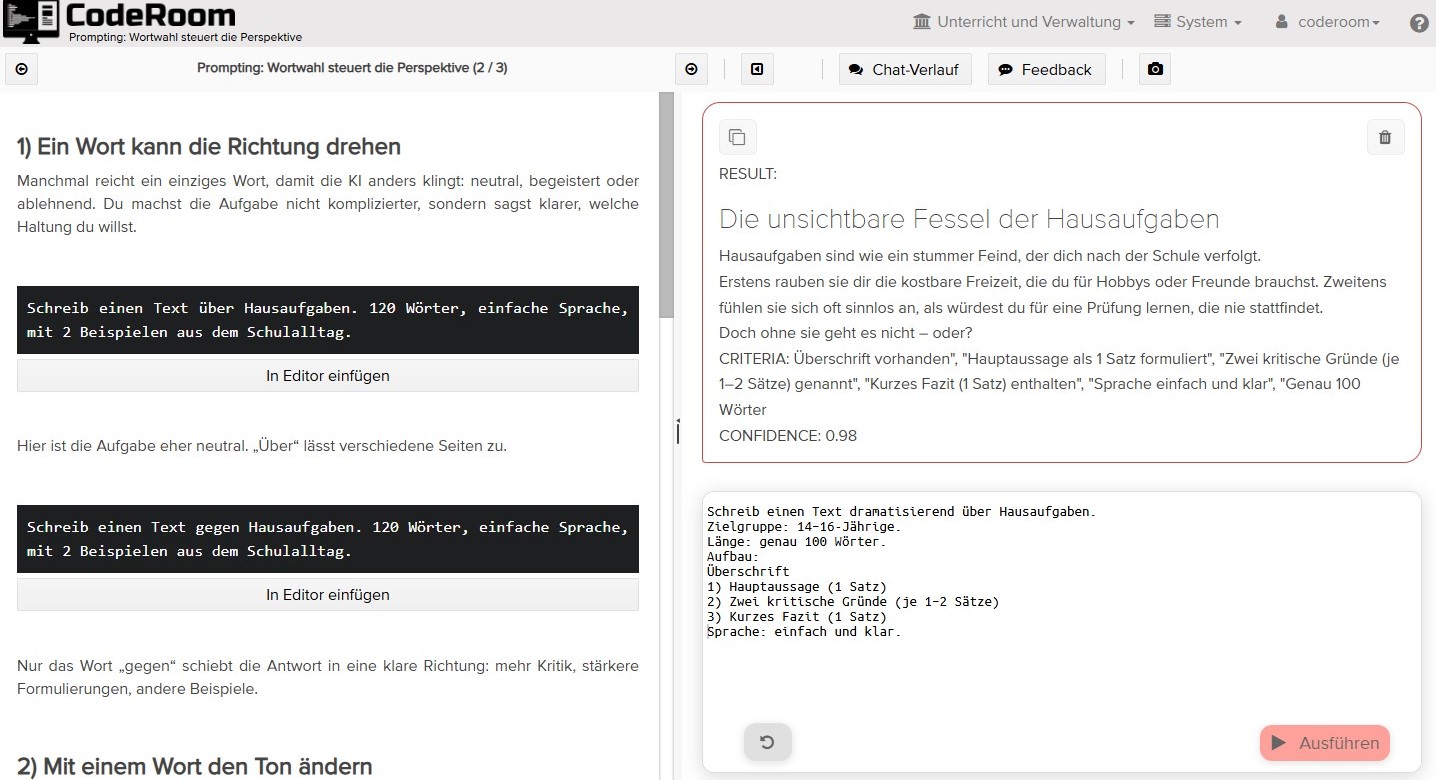
Prompting: Word choice steers perspective
This component makes linguistic control visible and guides the systematic neutralization of perspective-influencing formulations.
Prompting: Recognize hallucinations & make uncertainty visible
This component establishes a prompt check for transparency of uncertainty and promotes verifiable, traceable statements in answers.
Adjust explanations (level, target group, example)
This component structures prompts for adapting explanations and shows how follow-up prompts can be used to simplify them.
Prompting: KI as a learning coach (questions instead of solutions)
The module focuses coaching prompts with role and rule setting to create support through questions rather than pattern solutions.
Prompting: Improving answers without starting over (Follow-up Prompts)
The module trains controlled iteration by changing only one parameter at a time while maintaining stable output formats.
Prompting: Verifying facts instead of simply believing
The module uses fixed format rules to separate facts and opinions, making it possible to consistently demand verification possibilities.
Prompting: Recognizing bias & clichés in AI texts
The module operationalizes bias recognition through numbering, marking, and concise justification as a reproducible analysis format.
Recognizing framing
The module sharpens the focus on leading word choice by marking, collecting, and contrasting framing patterns.
Forcing balance in AI responses (Handy in school)
The module sets formal fairness rules (Pro/Contra, tone, length) and concludes with an independent position formulation.
Understanding data protection: Why personal data is worth protecting
The module explains data protection through examples and transfers the knowledge to responsible handling of today's person-related references.
Data Protection: Writing secure prompts
The module shows how sensitive information is recognized and replaced with placeholders and general descriptions without losing its purpose.
Personal effort, transparency, and ethical boundaries in AI
The module structures criteria for fair AI use through a traffic light scheme and leads to transparent labeling.
Contents at a glance
| Module | Focus | Duration |
|---|---|---|
| Clear prompts, better answers | Prompt structure with additions and module roles, tasks, and formats | 15 min |
| Prompting: Word choice influences perspective | Effect of leading words and neutralizing one-sided formulations | 15 min |
| Prompting: Recognize hallucinations & make uncertainty visible | Prompt check to make uncertainty visible and verifiable | 12 min |
| Explainations adapted (level, target group, example) | Target group specification, scope control, and simplification through follow-up prompts | 12 min |
| Prompting: AI as learning coach (questions instead of solutions) | Role assignment and question formats with prohibition of finished solutions | 12 min |
| Improve answers without starting over (Follow-up Prompts) | Iterative improvement through parameter change and fixed output format | 12 min |
| Prompting: Verify facts instead of just believing them | Format rules for separating facts from opinions with verification options | 12 min |
| Prompting: Recognize bias and clichés in AI text | Make clichés visible through numbering, marking, and brief explanation | 12 min |
| Recognize framing | Mark framing through word choice and collect as a pattern | 15 min |
| Enforce balance in AI responses (Handy in school) | Balance pros and cons, tone, and length, with revision and personal position | 12 min |
| Understanding data protection: Why personal data is worth protecting | Data protection explanation through examples and application to current personal relationships | 30 min |
| Data protection: Writing secure prompts | Recognize sensitive data and replace with placeholders and general descriptions | 30 min |
| Effort, transparency, and ethical boundaries in AI | Traffic light system for evaluation and formulating transparent labels | 30 min |
The course template bundles central aspects of category 594 in a traceable sequence of analysis, structuring, and iterative improvement of prompts.
Use the demo access to test the template and adapt the modules to your teaching situation.